Wednesday, September 26, 2012

Anticipation & Convergences


I have finished eleven reviews over the last three months.  I write these reviews because I like the books and I want to let everyone know how to find and support them.  The thing is once I publish a review I continue to get updates from and about artists.  As I move on to the next artist I am getting all these awesome little tidbits that I haven't been sharing.  I asked Geoff Vasile for permission to use images from his books.  He said sure.  He also said that he was moving most of his web-presence to The Geoff Vasile Show! on tumblr.   I bit the bullet and set up a tumblr account.  I found out that about half of the artists who had stopped updating their web pages are now posting on tumblr.  On a side note, Vasile posted this new slick silk screened cover for issue four of Trackrabbit.

Robinson's take on Fin & Jake
Now on tumblr, I have started to see Andy Hirsch promoting this Adventure Time book that Liz Prince had been mentioning.   Not having Kids or cable I really had no idea what Adventure Time is.  Everyone else seems to already have been keyed into Adventure Time.  The young woman running the register at Austin Books all but rolled her eyes at me when I asked if all the issues of Adventure Time had back-up stories by indie artist.  Turns out I had been seeing a lot of Adventure Time fan art floating around the intertubes.  I just had failed to draw the connection.  Unsurprisingly Alex Robinson's attempt at The Wonderful World of Alx Robinson is both awesome and a little freaky.

Hirsch did the art for the B alternate cover for the third issue of Adventure Time:Marceline and the Scream Queens.  He will also be doing a cover of another issue in November.  Hopefully this is a good link, if not he posted both covers at It's Andy Hirsch.   The six issue Marceline series were done by Meredith Gran.  Gran has been rocking out her own web-comic called Octopus PieOctopus Pie: There Are No Stars In Brooklyn, is a hoot and brought back the few fond memories I have of Brooklyn.  Hirsch 's cover highlights Liz Prince's seven page back-up story.  I ran out and got it but starting at issue three of six left me a little at sea.  Gran's work seams like some solid story telling.  Prince's back-up story Fruit Salad Days is hilarious and stands on its own.  With the Hirsch cover it is totally worth the cover price all on its own.
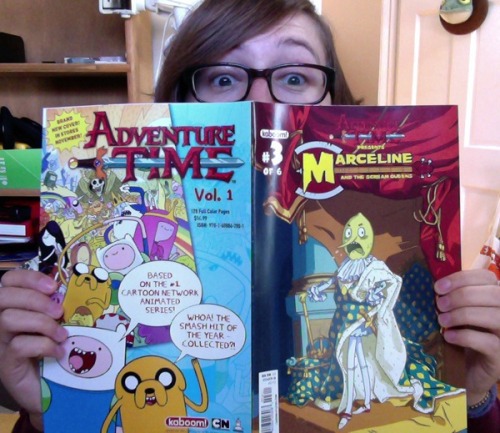
Prince with Hirsch's Cover
So that's where things I had been anticipating converged.  Some of the other things I am looking forward to have been in print for years.  Following Alex Robinson on social media is a reminder that I have three more reviews of already published work, that I hope to explore here. He also keeps on putting out teaser pages for the book he is currently working on.  He just posted page eighty-eight; it is ridiculous good but frustratingly gives almost nothing away.  Also, when I wrote my Guy Davis review Guy Davis Artworks was off line for renovation.  Now it is back up with many awesome preview pages including may works I missed.  From adverts in B.P.R.D. I knew I had missed Nevermen but I had no idea about The Zombies That Ate The World and some other work he did for Les Humanoides Associes.  As I track down those works there is also some work free of charge on My Space Dark Horse Presents

I came across two things slated for 2013 that have me chomping at the bit.  Monica Gallagher had mentioned that she had done some work for Oni but she has now announced that  Glitter Kiss will be coming out in January.  She is also stepping up Bonnie N. Collide to a twice weekly comic strip!  There are also all her mini-comics Boobage, When I Was A Mall Model and Go For The Eyes that I hope to review.  The 2013 news that has me jumping up and down is issue number four of Varmints!  I am not normally an exuberant guy.  As far as content goes, on the surface of it, Varmints is one of the lighter books that I follow.  While deeper things are developing, each issue stands on its own as a little comic adventure.  Hirsch recently posted a page that reminded me why I just can't wait to see where his work is going.  I have been accused of being dourer and I do hate musicals.  So why am I so giddy?   It is the audacity of having a singing dancing extravaganza conveyed only in static silent juxtaposed illustrations.   I would call bullshit on many others artists, but he makes it look easy.  You should go to It's Andy Hirsch and look at the larger  image.  I could (and may) write a entire review just on this page.

That's it for now.  I still have a stack of mini-comics to get through before I see what people bring to Artists' Alley at Austin Comic Con. 

Friday, September 21, 2012

Liz Prince's I Swallowed the Key to My Heart

In a word (or 3), Liz Prince rocks. She is a prolific cartoonist, cat lover, punk enthusiasts, and web maven. You can find her at two tumbler accounts, Fuck Yeah, Liz Prince and Fuck You, Liz Prince, a LiveJournal account there is no Liz, only zuul, a flickr account, a twitter account, and has over eighteen hundred Facebook followers.  Her web-site lizprincepower is also really cool.  I first learned about her on the interview she did for Indie Spinner Rack. Once I found her work I started to obsessively follow her, which she made really easy because of her web presence and her prolific posting.  A lot of her work to date has been single strip or singe page auto-biographical vignettes and a good deal of that can be found on her web-site free of charge.

The first two issues of I Swallowed the Key to My Heart got me to easily part with my money.  These two books are beautiful. They are self printed and distributed. They fit in the zine/mini-comic section of your store, but they are a massive 8.5″x11″ and the crisp black and white design of the book really stands out.

I keep on stressing the design and craft elements of these books and collections in these mini-comic reviews because I think they are more than decorative.  Each issue feels not only complete, but also intentionally complete.  Mini-comics have no publisher logo, bar code, nor any page or size limits.  They are an opportunity to experience a narrative object as nothing but an art object.  The hardbound editions of Tricked (on sale thru 9/28/12) and Essex County (out of print) are great examples of graphic design and book making, but there is something to say when the artist is responsible for editorial and quality control. But I digress...

I believe most of Prince's work is more cartoon journaling than auto-biography.  She shares funny and notable anecdotes about her life rather than tying them into a super narrative like Alison Bechdel's Funhouse.  The stories in I Swallowed the Key to My Heart are longer versions of her work.  In fact, the twenty plus pages of issue one transpire over a single night.  While there is an overarching narrative, Prince uses some of her comic strip sensibilities and so many of the pages can hold up as strips without context.  Dry wit and some sadness underneath very hip observations about absurdity in everyday life tie the piece together.

In interviews, Prince has talked about the loose and intentionally rough style she used in Will You Still Love Me If I Wet The Bed  and Delayed Replays.    If you start with the first strip on her web page, the format was a row of three panels with similar character framing and composition, the dialogue and subtle shifts in posture and expression tell the story.  If you continue to progress through the strips, her style tightens up and she starts to experiment with formats.  Some of her strips only really work in a web format, but the illustration always retains some of the playful looseness of her early work. 

She went BIG with I Swallowed the Key to My Heart.  The page layout is European with an average of four rows of two to four panels.  For me, that is one of the most exciting things about these books because Prince spent years refining her craft with very limited parameters.  I Swallowed the Key to My Heart is a chance to see her bring all of that skill to bear on a big canvas.  You can (and should!) pick a copy up from her store, or in person at one of the many con appearances she announces on her news section. She also has plenty of free content, so you have no excuse not check it out.


Wednesday, September 12, 2012

Geoff Vasile's Trackrabbit

Trackrabbit
by Geoff Vasile


This is a review of Trackrabit issues one through four. There is also a fifth issue available at Vasile's website. You can check out some his work for free on his tublr page.  Vasile calls Trackrabit his "one-man fiction anthology."  To date, he has alternated between science fiction and twenty something slice of life stories.  I wanted to start these mini comic reviews with Geoff Vasile because he had the strongest collection of mini-comics by creators that I met for the first time at Staple! 2012.  Later this month I'll be reviewing some artists who I knew of before the '12 expo as well as a few I have yet to meet.

Initially, I wanted to focus on the writing in Trackrabit.  Each issue contains a single stand alone story of twenty-four to forty pages.  In my first read, his writing stood out as more innovative and personal than the artwork.  My impression is that Vasile packs a lot of story telling in those few pages without being overly textual.  I came away from each issue feeling like I had spent far more time with the characters than I had.  With a re-read, it became clear that this is as much a product of Vasil's skill as an illustrator as his skill at prose and dialogue.

Panel choices are a big part of what is not visible in McCloud's formulation of comics as the "Invisible Art."  Vasile's break down of pages shows his talent for very conservatively cutting unnecessary scenes and panels.  While his illustration lacks the showiness and/or hyper stylization that I am a sucker for, there is a solidness to it that actively propels the story without getting in the way.  It is his skills as a graphic storyteller that masks the very skills he uses.

The second thing that has to be said about Vasile's Art is his professionalism.  In a world of near infinite digital content, part of what fans of Mini/DIY Comics are buying is the physicality of the book as art object.  This can be a splashy use of artistic and crafty flourishes that can only be accomplished in very small print runs.  It can just be a basic attention to detail and design that sets one book apart from another in any form of publishing.  Each of these issues is progressively more and more professionally designed (issue four looks like it is ready to be distributed by Top Shelf), yet there is a wonderful handmade quality to them.  

While the pacing is very different I think if you enjoyed the work of Alex Robinson you should check out the Ignatz nominated Trackrabit issues 2 and 3.  They both craft well balanced completely fictional narratives with the feeling of brutal honesty of auto-bio comics.

There are people who I would just suggest reading issues 1 and 4 and people who I would steer towards 2 and 3.  Nevertheless, I do believe all four issues of Trackrabit hold together.  The work that I keep thinking about is Jaime Hernandez's first volume of the Love and Rockets magazines.  There is a combination of very real people in almost accidental science fiction settings that speaks to the very unreality of very real situations.  You can get copies of Trackrabit as well as a few other books at his website.  I picked up Vasile's short auto-bio work A History of Increasing Humiliation at Staple!.  I just found more auto-bio work he has posted to his tumblr account.  This week I wanted to focus just on Trackrabit, but I will come back to his work.


Wednesday, September 5, 2012

Epic


So there are few things I want to get back to with this blog.  I should mention that Indie Spinner Rack is back on air.  If you're not familiar with their work check out the back catalog   They have had some terrific interviews over the years.  I also got around to checking out Mr. Phil's tumbler account and it is pretty cool.  In September and October I want to get back to reviewing mini comics.  Artist who are self publishing are the most likely place to find the bleeding edge of comics as an art form.  I have a stack of zine sized comics from two years of comic conventions, Austin Books and Domy Books.  I also have large stack of exceptionally long works that I want to get deeper into.


I may be less regular reviewing mini comics because I don't want to publish it without clearing it with  the author.  Most of these books were available for purchase through personal web sites but some times they sell out never to be printed again.  So I want to make sure that I am not going to send you down a rabbit hole by talking up some once in a life-time you had to be there publication.

I have thought about really digging into some long running creator owned comics.  David Sim's Cerebus  ran to issue 200 from 1977-2004 and although I own the first 5 collections I have yet to get through Church and Sate.  I know there is some controversy over some things he said and wrote.  Never the less Cerebus is one of the the first, most regular and longest running creator owned comics.   Conversely I have read all the Love and Rockets collections the Hernandez brothers' published from 1982 to today.  Jaime Hernandez went on to continue his Locas just as Gilbert continued stories featuring the Palomar cast of characters. 

There are a few more of these epic series that really need mentioning.  Before Scott McCloud wrote Understanding Comics he worked on a series called Zot! and continued in an amazing web comic.  I came late to Jeff Smith's Bone and Terry Moore's Strangers in Paradise, but they are awesome.  Both series are complete and well worth checking out but both Smith and Moore are continuing with new projects that you can check out at  Boneville and strangersinparadise.com respective.  Douglas Wolk's  Reading Comics introduced me to Carla Speed McNeil's Finder comics.  They were hard to find but now that Dark Horse is distributing them I have a lot of catching up to do.

I don't feel like I have the time to read and re-read Strangers in Paradise in its entirety just for a one page review, nor do I feel like suspending this blog and writing a treatises on it that no one will read.  So, here is my idea. I would love to start an on-line book club.  If anyone who reads this blog is interested in reading and discussing any of the titles, please e-mail me.  I will make a list if I can get enough people interested. We can see if we can plan a little forum in the comment sections.


Saturday, September 1, 2012

Monica Gallagher's Bonnie N. Collide

Bonnie N. Collide
By Monica Gallagher


Normally I want to focus on Comic books rather than comic strips.  Bonnie N. Collide is the exception  that proves my reasons for this preference.   It is hard to develop and expand a sense of space and motion in three to five panel chunks.   You can see, here in her 72nd strip, Gallagher is challenging some of the spatially linear tendencies of the comic strip medium.  It takes some dramatic shifting angle on single character in motion to set up the punch-line.
http://eatyourlipstick.com/comic/bonnie-n-collide-72/
I think of comic strips as more like poetry that prose or more like punch-lines than comedies.  Bonnie N. Collide has been making serialized narrative out of stand alone vignettes.  Over that last five years of building narrative I have found myself more attached to Bonnie and the crew than Nona La Bette from Gallagher's long form comic Lipstick & Malice

Bonnie splits 90% of her time at here 9-5 job and 110% of her time at the roller derby.  She goes careening through her life, on and off the derby track, in skates and roller gear.  There is a great strip that explains the Roller Derby that you can skip to before digging into the story.

Bonnie's office is populated by the mundanely named Herb, Sherry, Barb, Greg, Carl and her love interest Stuart.  Her 'off' hours are spent in grueling practices and bruising competition with the more colorfully named Hattie Hellfire, Mimi Madness, Mouthpiece Molly, Fresh Meat Fran and Agro Amelia.  There is a playful unreality that normalizes Bonnie's office space derby antics.  The rest of the office is more or less normal with the exception of Herb who is a werewolf with a file cabinet of meat.  This is not a spoiler; you never see Herb with out hair sticking out of his button-down.  The magical unreality of it is that nobody in the office is reasonably disturbed by this.

I have come to count on Gallagher for strong well rounded female roles.  Bonnie takes her knocks; she has personal and competitive upsets but she always bounces back.  This is kinda rare in light of some of the genre and the medium expectation  of  a romantic comic strip.  Bonnie is a busy lady; she doesn't have time to sit around feeling sorry for herself.
http://eatyourlipstick.com/comic/bonnie-n-collide-61/
Bonnie N. Collide is a true romantic comedy.  Romance comics were briefly a possible alternative to the horror comics of the 1940's mainstream comics.  There has been more romance in the self published indie comics.  Both Jamie and Gilbert's long works in Love and Rockets as well the works of Terry Moore are explicitly romances.  I'd also like to give a shout out to Fade to Blue that I picked up the first trade paper back many years ago and am looking for issues 6-10.  There are also important romantic arches in Scott McCloud's Zot! and Wendy Pini's Elf Quest.  How excellently fitted the medium of comics are for romance is often overlooked.  To bring a romance to stage or screen you need not only a writer and director (Gallagher like all writer/illustrators wears both hats), you also need the skills of at least two actors and an x factor called chemistry.  Comics allow for the illustrator to do all of the acting. 
http://eatyourlipstick.com/comic/bonnie-n-collide-91/
What Gallagher shares with the Hernandez brothers, Moore, McCloud and Pini is a delight and mastery over expressive body language and dynamic facial expression.  Look at how expressive everyone is in strip #91.  She pulls this off with a minimum of lines.  Take the time to note how Gallagher refines her style over the course of this strip five year history.  It is a rewarding study in how much human emotion can be conveyed with a few elegant lines.

Part of the reason I felt I needed to review this strip is just how much enjoyment I have gotten out of Monica Gallagher's Bonnie N. Collide updates as well as her own blog.   You can follow these for free but the hand made Bonnie and Lipstick & Malice collections are pretty cool.  You can pick them up from her at her on-line store, as well as her auto-bio mini comics.  I still have to read Middle School and Go For The Eyes but her other mini comics have been awesome.  She had some great web content on her old web-site especially her Relentless Buzzing.  She should be uploading it at some point and you can keep eye on her page here.
The inspiration for my Blog came from Indie Spinner Rack and the way Charlito and Mister Phil created a community to encourage and celebrate indie comics.  The motivation that keeps me posting with some regularity is the example and advice that Liz Prince and Monica Gallagher shared at the Women of Webcomics panel discussion Staple! 2012 and in their regular posts.  You can meet Monica at Baltimore Comic-Con September 8-9 and at Emerald City Comic Con March 1-3 (which means we will miss her this year in Austin). 

Wednesday, August 22, 2012

Bandes Dessinées 3: Multiple Genre Medium


 Bandes Dessinées 3
Multiple Genre Medium


European comics have an extensive selection of science fiction titles.  I have already mentioned Enrico Marni's Gipsy.  American advocates of comics as the 9th art make a big deal of comics being a medium not a genre.  Super heroes are a genre that have become exclusively linked with comics.  In fact, the two largest comic book publishers hold a joint trademark on the term.  Comic book stores are such a stange market, the are served by only one distribution company.  So you can go over Diamond Comic Distributors and confirm that over seven out of every ten comics sold in comic shops is a super hero book.  In 2011, all but about a dozen mostly horror titles of the top 500 best selling comics of 2011 were super hero books.  I should note that the graphic novel/trade paperback list is much broader and those books are also sold by book stores that do not report numbers to Diamond.  The French comic book scene is far more diverse, and even though only a small fraction of those have been translated into English it still expands our market here in the U.S.A. 

I picked up The Metabarons: Poet and Killer and The Metabarons: Alpha / Omega by Jodorowsky, Gimenez, Charest and Moebius.  I can make some observation about the series even after skipping over the second volume of these editions.  There seems to be a few things lost in translation, this is a problem because language in SF can be strange without translation.  Jodorowsky has worn a lot of hats over his lifetime.  On top of being a renowned comic book writer he is also a prose writer, occultist and film maker.  Before doing The Incal and its prequel The Metabarons he spent about half a decade trying to bring Frank Herbert's Dune to screen.  You can see how much of Herbert rubs off on this work.  It is epic and while it is slightly silly it is strangely Shakespearean.  You can find copies directly from Humanoids, the English language publisher.
A page from Ortibal

So I read, Orbital: Vol. 1  Scars by Serge Pelle and Sylvain Runberg.  Runberg has a good running start at an epic space opera but there just isn't enough in the first volume for me to make a judgment.   Serge Pelle art is amazing and the translation is very readable.  The entire series is available in print and English amazon.com.  This is becuse of this intresting company called Cinebook.  This U.K. company is actively trying to bring high art comics across the English Channel. You find their catalogue at cinebook.com, but prices are listed in  pounds. 

Last but not least, my final finds were VALERIAN spatiotemporal agent: Ambassador of the Shadows & VALERIAN spatiotemporal agent: World Wthout Stars by  Jean-Claude Mezieres & Pierre Christin.  From the 1970, VALERIAN & LUARELINE appears to be giant among the shelves of the Bandes Dessinées.  I should mention that allot of the dust jacket info highlights the connection to and influence on Star Wars.  What is more telling for me is the list of creators that praise it:  Will Eisner, Harvey Kurtzman and Jim Steranko all heavy hitters in and out of mainstream comics.  The praise for these first two volumes of VALERIAN spatiotemporal agent is understandable.  It really does feel like George Lucas partnered with Wally Wood to create a big sand box of a space opera.  The publisher, Dargaud International, is a division of its French publisher.  I found out that I can get ahold of the French editions here in Austin so I will return to these after I run out of English translation with Bandes Dessinées 4(or possibly 5): Enki Bilal.  Before that I will be returning to some self published work.

Tuesday, August 14, 2012

Tommy Kovac & Andy Hirsch's The Royal Historian Of OZ

The Royal Historian Of Oz
Tommy Kovac & Andy Hirsch


The Royal Historian of Oz is one of the many comic books to build on the modern fairy tales of the turn of the last century.  Oz, Wonderland and Neverland have all become geographical back drops for comics.  Because Oz is an epic sprawling fantasy with plenty of room for interpretation while falling safely in the public domain, it is a natural enough fit for comics.

One thing that sets The Royal Historian of Oz apart is the way it actively and self-referentially  places its self in the tradition of Oz adaptions.  For example, even Kovac's title is an allusion to a tradition, started by Frank Baum, of referring to the author of Oz stories as a 'historian' of Oz.


The Royal Historian of Oz starts off in a slightly alternate near future.   Like Baker Street's London, Kovac's "broke-down weary future" allows for greater literary license and zeppelins.  The story follows Frank and his father Jasper Fizzel.  To Frank's chagrin, Jasper is persistently cranking out Oz fan fiction to the detriment of any help to the household.  Jasper is hounded by the ruthless but ridiculous fictional Official Oz Society (not the real International Wizard's of Oz Club).  The  Official Oz Society police all Frank  Baum's intellectual properties.  In a fantastic turn of events, Jasper manages to cross over into Oz in an attempt to vindicate himself.  This only manages to make more of a mess of things for everyone and leaves Frank stuck in the middle.

OZprint020In researching this review, I found a copy of Wonderland.  It utilizes the writing talents of Kovac and the illustrations of Sonny Liew.  Kovac clearly has an understanding of the inner-workings of the modern fairy tale.  He also has a glibness that is contemporary without being anachronistic.  He keeps The Royal Historian of Oz accessible to readers whose knowledge of Oz is limited to passing familiarity with Scarecrow, Dorothy and Ozma.  Nevertheless Kovac does spend a little time geeking out on less known members of the Oz pantheon like Button Bright and the Glass Cat.  Tommy Kovac also has a pretty comprehensive web page and a highly entertaining blog.

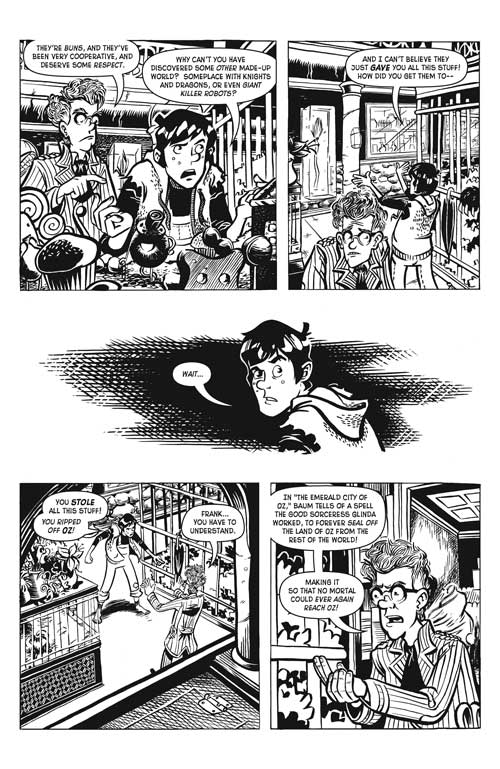
For me, Andy Hirsch steals the show.  There isn't as much multi-panel motion as his self produced Varmints.  In The Royal Historian of Oz panel breakdown would be most dictated by Kovac's script.   Hirsch's talent mostly shines through in his panel composition.  When talking about panel composition it is easier to talk about it in terms of camera angles.   Hirsch shoots up, down and off to the sides that allow for a sense of motion in static single panel.  Take a look at the fourth panel of page above.  There is a minimum of action in the page as dialogue goes back and forth.   The over head angled shot gives the impression that you actually saw the steps as Frank pivots and points.  Another thing to check out is all of the chewy scenery.  The level of detail in the first two panels is a mainstay of the book.  To give him feed back or check out what he is currently working on, visit A is for Andy or darnvarmints

Jasper brings a flying monkey named Zik back from Oz.  Zik is monosyllabic with a noticeably inhuman face.  Zik's ability to emote and his comic timing really highlight the strength of Kovac and Hirsch's collaboration.  Both men are capable of stealing a scene.  For example note some of Jasper's monologues or the visual funkiness of Patchwork Girl at the end of issue four.  But I feel that there is an equilibrium on the character of Zik that shows off what both men bring to the work.

You can buy the individual issues or the pocket sized trade paper back from Slave Labor Graphics.  The first three issues are also for sale from the Comixology smart phone application.