Wednesday, August 22, 2012

Bandes Dessinées 3: Multiple Genre Medium


 Bandes Dessinées 3
Multiple Genre Medium


European comics have an extensive selection of science fiction titles.  I have already mentioned Enrico Marni's Gipsy.  American advocates of comics as the 9th art make a big deal of comics being a medium not a genre.  Super heroes are a genre that have become exclusively linked with comics.  In fact, the two largest comic book publishers hold a joint trademark on the term.  Comic book stores are such a stange market, the are served by only one distribution company.  So you can go over Diamond Comic Distributors and confirm that over seven out of every ten comics sold in comic shops is a super hero book.  In 2011, all but about a dozen mostly horror titles of the top 500 best selling comics of 2011 were super hero books.  I should note that the graphic novel/trade paperback list is much broader and those books are also sold by book stores that do not report numbers to Diamond.  The French comic book scene is far more diverse, and even though only a small fraction of those have been translated into English it still expands our market here in the U.S.A. 

I picked up The Metabarons: Poet and Killer and The Metabarons: Alpha / Omega by Jodorowsky, Gimenez, Charest and Moebius.  I can make some observation about the series even after skipping over the second volume of these editions.  There seems to be a few things lost in translation, this is a problem because language in SF can be strange without translation.  Jodorowsky has worn a lot of hats over his lifetime.  On top of being a renowned comic book writer he is also a prose writer, occultist and film maker.  Before doing The Incal and its prequel The Metabarons he spent about half a decade trying to bring Frank Herbert's Dune to screen.  You can see how much of Herbert rubs off on this work.  It is epic and while it is slightly silly it is strangely Shakespearean.  You can find copies directly from Humanoids, the English language publisher.
A page from Ortibal

So I read, Orbital: Vol. 1  Scars by Serge Pelle and Sylvain Runberg.  Runberg has a good running start at an epic space opera but there just isn't enough in the first volume for me to make a judgment.   Serge Pelle art is amazing and the translation is very readable.  The entire series is available in print and English amazon.com.  This is becuse of this intresting company called Cinebook.  This U.K. company is actively trying to bring high art comics across the English Channel. You find their catalogue at cinebook.com, but prices are listed in  pounds. 

Last but not least, my final finds were VALERIAN spatiotemporal agent: Ambassador of the Shadows & VALERIAN spatiotemporal agent: World Wthout Stars by  Jean-Claude Mezieres & Pierre Christin.  From the 1970, VALERIAN & LUARELINE appears to be giant among the shelves of the Bandes Dessinées.  I should mention that allot of the dust jacket info highlights the connection to and influence on Star Wars.  What is more telling for me is the list of creators that praise it:  Will Eisner, Harvey Kurtzman and Jim Steranko all heavy hitters in and out of mainstream comics.  The praise for these first two volumes of VALERIAN spatiotemporal agent is understandable.  It really does feel like George Lucas partnered with Wally Wood to create a big sand box of a space opera.  The publisher, Dargaud International, is a division of its French publisher.  I found out that I can get ahold of the French editions here in Austin so I will return to these after I run out of English translation with Bandes Dessinées 4(or possibly 5): Enki Bilal.  Before that I will be returning to some self published work.

Tuesday, August 14, 2012

Tommy Kovac & Andy Hirsch's The Royal Historian Of OZ

The Royal Historian Of Oz
Tommy Kovac & Andy Hirsch


The Royal Historian of Oz is one of the many comic books to build on the modern fairy tales of the turn of the last century.  Oz, Wonderland and Neverland have all become geographical back drops for comics.  Because Oz is an epic sprawling fantasy with plenty of room for interpretation while falling safely in the public domain, it is a natural enough fit for comics.

One thing that sets The Royal Historian of Oz apart is the way it actively and self-referentially  places its self in the tradition of Oz adaptions.  For example, even Kovac's title is an allusion to a tradition, started by Frank Baum, of referring to the author of Oz stories as a 'historian' of Oz.


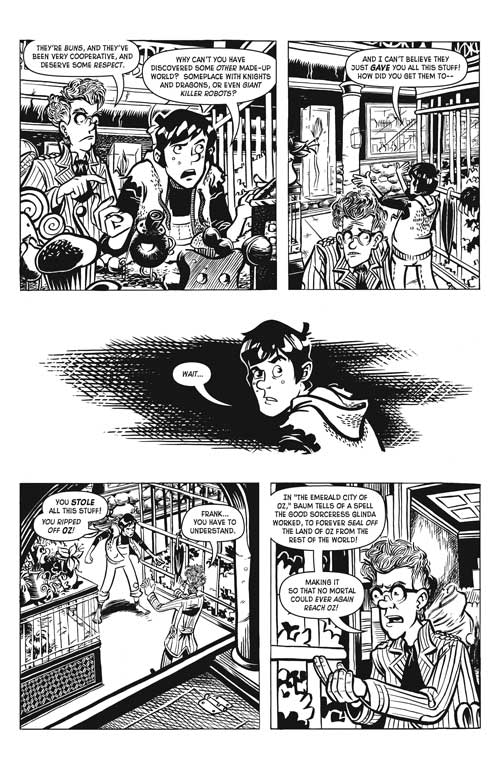
The Royal Historian of Oz starts off in a slightly alternate near future.   Like Baker Street's London, Kovac's "broke-down weary future" allows for greater literary license and zeppelins.  The story follows Frank and his father Jasper Fizzel.  To Frank's chagrin, Jasper is persistently cranking out Oz fan fiction to the detriment of any help to the household.  Jasper is hounded by the ruthless but ridiculous fictional Official Oz Society (not the real International Wizard's of Oz Club).  The  Official Oz Society police all Frank  Baum's intellectual properties.  In a fantastic turn of events, Jasper manages to cross over into Oz in an attempt to vindicate himself.  This only manages to make more of a mess of things for everyone and leaves Frank stuck in the middle.

OZprint020In researching this review, I found a copy of Wonderland.  It utilizes the writing talents of Kovac and the illustrations of Sonny Liew.  Kovac clearly has an understanding of the inner-workings of the modern fairy tale.  He also has a glibness that is contemporary without being anachronistic.  He keeps The Royal Historian of Oz accessible to readers whose knowledge of Oz is limited to passing familiarity with Scarecrow, Dorothy and Ozma.  Nevertheless Kovac does spend a little time geeking out on less known members of the Oz pantheon like Button Bright and the Glass Cat.  Tommy Kovac also has a pretty comprehensive web page and a highly entertaining blog.

For me, Andy Hirsch steals the show.  There isn't as much multi-panel motion as his self produced Varmints.  In The Royal Historian of Oz panel breakdown would be most dictated by Kovac's script.   Hirsch's talent mostly shines through in his panel composition.  When talking about panel composition it is easier to talk about it in terms of camera angles.   Hirsch shoots up, down and off to the sides that allow for a sense of motion in static single panel.  Take a look at the fourth panel of page above.  There is a minimum of action in the page as dialogue goes back and forth.   The over head angled shot gives the impression that you actually saw the steps as Frank pivots and points.  Another thing to check out is all of the chewy scenery.  The level of detail in the first two panels is a mainstay of the book.  To give him feed back or check out what he is currently working on, visit A is for Andy or darnvarmints. 

Jasper brings a flying monkey named Zik back from Oz.  Zik is monosyllabic with a noticeably inhuman face.  Zik's ability to emote and his comic timing really highlight the strength of Kovac and Hirsch's collaboration.  Both men are capable of stealing a scene.  For example note some of Jasper's monologues or the visual funkiness of Patchwork Girl at the end of issue four.  But I feel that there is an equilibrium on the character of Zik that shows off what both men bring to the work.

You can buy the individual issues or the pocket sized trade paper back from Slave Labor Graphics.  The first three issues are also for sale from the Comixology smart phone application. 

Tuesday, August 7, 2012

Overtime

So it's been five weeks without a cigarette, and  it's been more or less successful.  I will be dropping the patch in the next few days.  I am writing to apologize for missing this weeks post.  I have been working six day weeks but have a mini vacation over the horizon.  I do have a review that I am looking forward to.   I am close to finishing it but I want to do some more research.  I'll be back next week.

Wednesday, August 1, 2012

Robert Venditti & Mike Huddleston's The Homeland Directive


The Homeland Directive
Robert Venditti & Mike Huddleston


The Homeland Directive is one of my favorite conspiracy thrillers of any medium.  As a genre, original thrillers have been under represented in comics.  I've mentioned Pierre Christin and Enki Bilal's The Hunting Party.  Also of note is Brian Azzarello and Eduadrdo Risso's 100 Bullets.  They are the exceptions that prove the rule.  The Homeland Directive is not just a  magnificent comic book.  Before diging into how it takes advantage of comics as a medium I want to say a few things about the writer and the story.

Robert Venditti has mostly worked for Top Shelf.  Apparently he started out as a volunteer in the mail room.  His first and continuing  series The Surrogates was a runaway success for Venditti and Top Shelf.   What made that series so enjoyable for me was not its glimpse into a wildly innovative dystopia nor was it the wonderful collaboration between writer and artist.  Rather it is Venditti's talent for telling stories squarely in the realm of genre fiction that take unpredictable but unforced twists with three dimensional characters.

These twists and dimensionality shine through in The Homeland Directive.  Without giving too much away, by page 24 you find out that the main character is caught betwean a conspiracy and a counter-conspiracy.  Venditti uses this to side step some genre tropes which I always had as pet-peeves.  The conspiracies are not global with unlimited  and unrealistic resources brought down by a sequences of deus ex machinas.  Rather it is the missteps and overlooked facts that create the dramatic tension between the two conspiracies.  Unrealistic villains are always frustrating but the idea that a person or persons capable of manipulating multiple levels of governmental jurisdictions who need to stoop to melodramatic world domination is a bridge too far.  Venditti characters all have realistic and mixed motives behind their actions.   While there are clearly villains there are many levels of grey between them and the heroes.

As you can see in this page, Mike Huddleston uses lines very sparingly and his figure drawing is far simpler and more abstract than his work on Butcher Baker The Righteous Maker.  It is the coloring that really stands out in this book.  For most of the book the colors are light and lay on top of the heavier inks.  Unlike mainstream coloring this highlights the line work rather than completing or obscuring it.  The collaboration between Venditti and Huddleston results in some truly excellent storytelling.  They shift not just the color palette but color techniques as the narrative shifts between the perspectives of different players in the conspiracies.  It creates this wonderful and almost unique pacing and I strongly suggest you go check it out if you are a fan of the genera or the medium.
You can buy a hard or digital copy from Top Self. Also check out Robert Venditti bio-page.


Warning, possible spoiler alert.


I will moderate commitments for civility, but if people would rather use this blog as a chances to discuses the book amount folks that have already read the book, I am great with that.  So If you haven't read the book hold off on reading the comments until you have.

Tuesday, July 24, 2012

21 days without a cigarette

I am not sure about this post but I am kind of twitching from withdrawal and not ready to finish with either of the proper reviews I am working on.  What I was was doing with money before I started smoking was buying comics.  My mom sent me this link thought that brought it all back.


This video is kind of sad or the funniest thing ever.  Between the ages of elevan and fourteen I owned about 2 out of 3 of those books.  He must be a little younger than me or also a late bloomer.

Those books are from the early nineties.  The joke is that those comics were marketed as collectibles, so subsequently, were overproduced junk.

The sad or possibly ironic thing about this video is that it highlights the worse side effects of the false scarcity of the comic book market.  In the nineties there were literally thousands of comic books that were being sold to people who would never open them.   Which meant there were issues where five books were sold for every three that were read.   This excess production of never opened comics subsequently drove down the scarcity of each copy.

There was a silver, or at least limited addition foil lining, to all this speculation.  Because so many of these books were never opened, the cover art didn't just have to sell the book, at times it was the only thing being sold.   So there was a high premium on the art and many of the artists who were just getting name recognition in the late eighties became the selling points for the books they worked on.   This in turn allowed for a group of them to break off and start Image Comics the first really profitable high-profile creator owned publisher.

I am not claiming Image didn't have a lot of its own problems.  Back then it wasn't really offering much that Marvel or DC hadn't already offered.  Sam Keith's Maxx being the exception that proved the rule.  As it has sort of become it own thing, it largely did so by allowing that some of the more derivative aspects to re-enter the corporately controlled intellectual property driven industry of mainstream comics. 

While this was going on Karen Berger at DC was poaching all this crazy writing talent from Great Britain and starting up the Vertigo imprint of DC.   I feel (this may just be auto-biographical), that the backlash against comics that were not for reading collided with Vertigo's track record of having books whose writers and not illustrators were the big selling point.


That was over a decade ago and I really don't have my hand any where near the pulse of main stream comics but I hope this had lead to some equilibrium.  I guess I can use that hope as transaction because the two reviews I am working on are writer/artist teams.

Monday, July 16, 2012

Bandes Dessinées 2


So, I wanted to do a quick survey of all the English translations of French Comics that I could get my hands on.  My first thought was to pick up some Richard Corben.  His work was all over France and I had seen plenty of his stuff here in the standard Bandes Dessinées album size.  Lately he  has been publishing a lot of stuff through Dark Horse that you can check it out here.    Thing is, I am embarrassed to have just discovered, Richard Corben is an American who has been working on comics in America for over 40 years.  I sort of became familiar with his work as a well established artist who was filling in on Hellboy.  Apparently his first really big break was in Metal Hurlant the French anthology founded by Mœbius that is the precursor to the trans-Atlantic Heavy Metal.  From what I gather Mœbius is the Akira Kurosawa of comic books.  So here are five books and four series that have found so far.

I picked up the first two albums of Massimiliano Frezzato's Keepers of the Maser Series.  He is Italian, of Heavy Metal fame, and his work was everywhere in France.  Unsurprisingly it is gorgeous.  English translations can be bought from Heavy Metal.  From my quick survey of these first two albums, the story is reminiscent of darker more sexual  Castle in the Sky or Nausiccaa.

The Hunting Party - Hardcover Album : The Hunting Party
I took a look at the first volume Enrico Marni's Gipsy.  From the 61 pages it seems to be a near future action romp.  It's fun genera fiction.  I didn't feel there was enough to make a judgement but there is a longer collection put out by Heavy Metal. 

The artist Enki Bilal, who is also a veteran of Metal Hurlgeant, is in fact a French citizen.  Pierre Christin and Enki Bilal's The Hunting Party is exactly what I feel is missing from the American comic book marcket.  It is a political thriller between Eastern Block political operatives set towards the end of the cold war.   It is published by Humanoids,  which has an impressive line up of Franco/Belgian comics.

I haven't found any Mœbius books yet.  The Metabarons: Path of the Warrior by Jodorowsky and Gimenez is a prequel to a a set of books called Incal by Jodorowsky and Mœbius.  Like Frezzato and Bilal's work, The Metabarons is painfully pretty.  This edition is strange. They reformatted it to fit the standard American comic book format.  This means there are next to no left or right margins but larger blank space at the top and bottom of the page.  It looks like this collection is the first one and a half albums that can be found here from Humanoids.

That is it for now.  I am going to go back to American creator-controled work for a while, but I will be back to the European scene shortly.  I also need to delve into some of Richard Corben's work.


Monday, July 9, 2012

David McKean & Neil Gaiman's Signal to Noise

David McKean & Neil Gaiman's Signal To Noise 


Signal To Noise follows the middle-aged film director as he discovers and deals with late stage cancer while working on a script about the 999AD apocalypse that wasn't.  The narrative shifts between him and the lives of the midevil villagers of his script he is writing for and audience of one.  Appropriately Signal To Noise is short on resolution.  The story does throw the reader into the division of between the intended and received work of of art.

Signal To Noise came out in the early nineties.  I came across it latter in decade back before I started smoking when I was still visiting comic book stores weekly.  I think of it as part of trilogy falling in between Violent Cases and The Tragical Comedy or Comical Tragedy of Mr. Punch. At 48 to 96 pages, all three are relatively short for bound American collection but long for stapled comic books.  They are much closer to Bandes Dessinées format. 

The McKean's artwork in all three is unreal.  It is closer to mix media and collage work he did for covers for comic books and CDs.  But the simple but elegant line work he used in Cages occasionally peaks trough.  His color pallet creates a depth to the page without overwhelming the narrative flow.

I ended up putting this review off until the last minute I hope to come back to these three books.  I had planed to review another book from Top Shelf but couldn't get a hold of it.  I picked a copy of Signal to Noise one off my book case I think I lent Violent Cases out.  Dark Horse has released a a new edition that appears to have some interesting bonus material.  I hope to get a weak or two ahead over the next few days as a way taking my mind over the withdraw.